July 29, 2019
Triton orbits Neptune, the eighth planet from the Sun, some 2.7 billion miles from Earth—at the cold outer fringe of the Solar System’s major planet zone. Surface temperatures hover near absolute zero, so low that common compounds we know as gases on Earth freeze into ices. Triton’s atmosphere, which is 70,000 times less dense than Earth’s, is composed of nitrogen, methane and carbon monoxide.
These extreme conditions have led to an extraordinary discovery on Triton. An international team of scientists used the 8-meter Gemini South Telescope in Chile to pinpoint a very specific type of infrared light signature produced when carbon monoxide and nitrogen molecules join together and vibrate in unison. Individually, carbon monoxide and nitrogen ices each absorb their own distinct wavelengths of infrared light, but the tandem vibration of an ice mixture absorbs at an additional, distinct wavelength identified in this study.
The discovery, recently published in the Astronomical Journal, offers insights into how this volatile mixture can transport material across the moon’s surface via geysers, trigger seasonal atmospheric changes and provide a context for conditions on other distant, icy worlds.
“While the icy spectral fingerprint we uncovered was entirely reasonable, especially as this combination of ices can be created in the lab, pinpointing this specific wavelength of infrared light on another world is unprecedented,” said NAU professor Stephen Tegler, who led the study, collaborating with Will Grundy and Jennifer Hanley of Lowell Observatory. Other co-authors from NAU are Terry Stufflebeam, Shyanne Dustrud, Gerrick Lindberg, Anna Engle, Thomas Dillingham, Daniel Matthew and David Trilling.
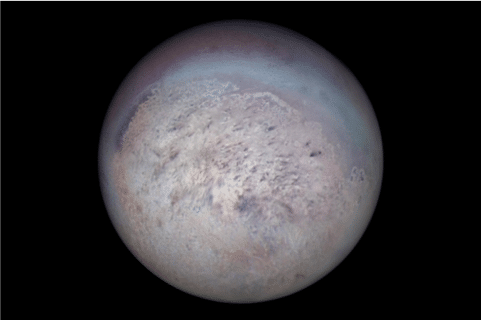
In the Earth’s atmosphere, carbon monoxide and nitrogen molecules exist as gases, not ices. In fact, molecular nitrogen is the dominant gas in the air we breathe, and carbon monoxide is a rare contaminant that can be lethal. On distant Triton, however, carbon monoxide and nitrogen freeze solid as ices. They can form their own independent ices or can condense together in the icy mix detected in the Gemini data. This icy mix could be involved in Triton’s iconic geysers first seen in Voyager 2 spacecraft images as dark, windblown streaks on the surface of the distant, icy moon.
Looking ahead, the researchers expect these findings will shed light on the composition of ices on other distant worlds beyond Neptune. Astronomers have suspected that the mixing of carbon monoxide and nitrogen ice exists not only on Triton, but also on Pluto, where the New Horizons spacecraft found the two ices coexisting. This Gemini finding is the first direct spectroscopic evidence of these ices mixing and absorbing this type of light on either world.
Tegler studies ices relevant to the surfaces of Kuiper Belt Objects in the Astrophysical Ice Laboratory using transmission and Raman spectroscopy. The laboratory is a collaboration between Lowell Observatory and NAU’s Department of Physics and Astronomy, which facilitates studies of cryogenic outer solar system materials, such as the methane and nitrogen ices that dominate the surfaces of Pluto, Triton, Eris and Makemake, and the ethane-methane-nitrogen liquids that flow across the surface of Titan.
The laboratory consists of two experimental stations, one for vapor deposition of thin ice films, and one for more massive samples of cryogenic liquids and ices up to 2 cm thick. Instruments used to analyze cryogenic materials include Fourier-transform infrared spectroscopy, mass spectroscopy and X-ray photoelectron spectroscopy.
Photo: Voyager 2 image of Triton showing the moon’s south polar region. Credit: NASA/JPL

Kerry Bennett | Office of the Vice President for Research