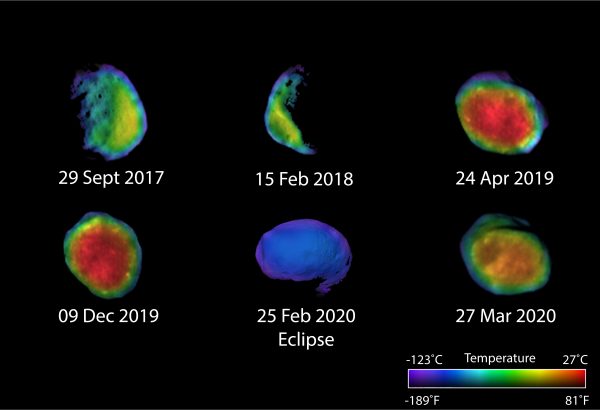
Christopher Edwards, assistant professor in NAU’s Department of Astronomy and Planetary Science, just processed new images of the Martian moon Phobos that give scientists insight into the physical properties of the moon and its composition. The images of the small moon, which is about 25 kilometers (15 miles) in diameter, were captured by NASA’s 2001 Mars Odyssey orbiter. When reviewed in combination with three previously released images, these new images could ultimately help settle the debate over whether the planetary body is a “captured asteroid”—pulled into perpetual orbit around Mars—or an ancient chunk of Mars blasted off the surface by a meteorite impact.
Along with scientists at NASA’s Jet Propulsion Lab and Arizona State University, Edwards used the Thermal Emission Imaging System (THEMIS) onboard the 2001 Mars Odyssey orbiter to capture the images from about 6,000 kilometers (3,700 miles) above the moon’s surface to measure temperature variations during different phases—waxing, waning and full:
- An image taken on December 9, 2019, shows the surface of Phobos at its maximum temperature, 81 degrees Fahrenheit (27 degrees Celsius).
- An image taken on February 25, 2020, shows Phobos while in eclipse, where Mars’ shadow completely blocked sunlight from reaching the moon’s surface. This event resulted in some of the coldest temperatures measured on Phobos to date, with the coldest being about -189 degrees Fahrenheit (-123 degrees Celsius).
- On March 27, 2020, Phobos was observed exiting an eclipse, when its surface was still warming up.
Edwards has been a part of the THEMIS team since 2003. All of the THEMIS infrared images are colorized and overlain on THEMIS visible images taken at the same time, except for the eclipse image, which is overlain on a synthetic visible image of what Phobos would have looked like if it hadn’t been in complete shadow.
“The THEMIS instrument is designed to look at the composition and physical properties of the surface of Mars under various conditions using its multi-wavelength visible and infrared cameras,” Edwards said.
From the new images, he said, “We’re seeing that the surface of Phobos is relatively uniform and made up of very fine-grained materials. These observations are also helping to characterize the composition of Phobos, which appears to be mostly basaltic. Future observations will provide a more complete picture of the temperature extremes on the moon’s surface.”
Odyssey is the longest-operating spacecraft around Mars, and has been orbiting the Red Planet for more than 18 years.
“In an effort to continue advancing new science from the Odyssey mission as it matures,” Edwards said, “a couple of years ago we proposed we could look at Phobos as part of our extended mission proposal. That requires a BIG spacecraft maneuver, rotating it 180 degrees into a geometry in which it was never intended to operate.”
“As far as Phobos goes,” he said, “its origins are enigmatic. The orbit it is in is not very stable, and some scientists have proposed that the moon has been destroyed and reformed multiple times because of its orbital position. It also turns out that the orbit’s exact geometry makes it hard to capture—so some teams have proposed it is derived from Mars. How that happened is not clear, either! Perhaps it’s from a big meteorite impact that ejected material into the orbit, and the material grouped together to form Phobos. So that’s why we’re looking for the physical properties of the surface, which might help identify locations where we could see the primary composition and not just the fine-grained dust.”
Edwards added, “JAXA, Japan’s space agency, is sending a whole mission to investigate Phobos and Deimos (Mars’ other moon) called the Martian Moons eXploration (MMX), so we’re providing some good reconnaissance data for that upcoming mission!”

Kerry Bennett
Office of the Vice President for Research
(928) 523-5556 | kerry.bennett@nau.edu
This story has entered the national news