Jan. 4, 2019
A team of astronomers, including Northern Arizona University scientist Chad Trujillo, earlier this week announced their discovery of an object at about 120 astronomical units (AU) from Earth—the farthest observed object in the solar system. One AU represents the distance between the Earth and the Sun, approximately 93 million miles.
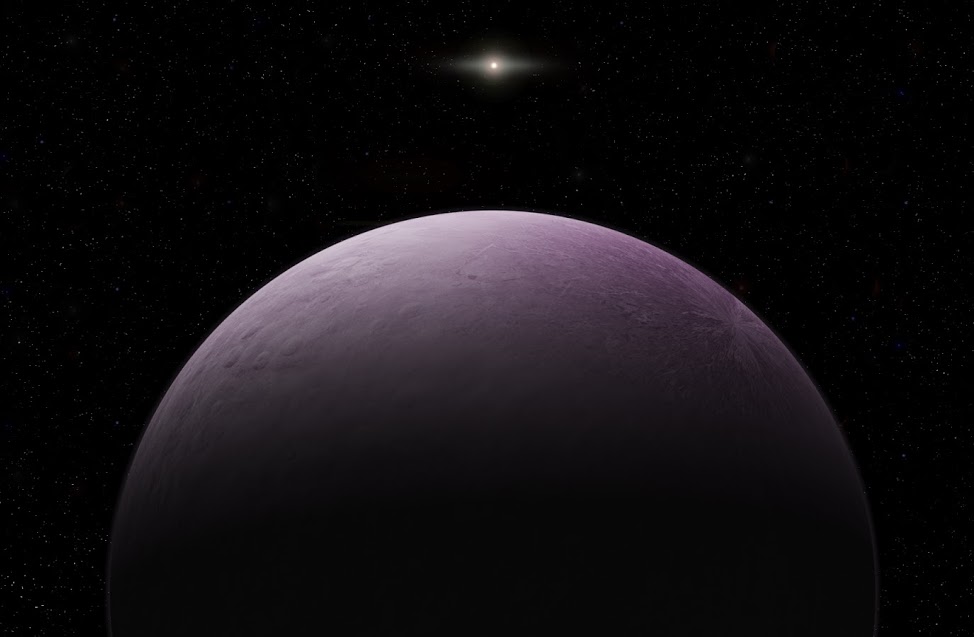
Nicknamed “Farout” by the discovery team—and formally designated 2018 VG18 by the International Astronomical Union—the object is pinkish in color and is estimated to be more than 310 miles in diameter, most likely meaning it is large enough to be considered a dwarf planet, like Pluto. The announcement has attracted attention by national media outlets including CNN, NBC News, Space.com and Science.
The team, which is comprised of Trujillo, Scott Sheppard of the Carnegie Institution for Science, and David Tholen of the University of Hawaii, has been searching for Planet X, believed to be on the edge of the solar system, since 2014. In addition to Farout, the team discovered 12 new moons of Jupiter in July as well as an object nicknamed The Goblin in October.
NAU grad student assists in recovery observations of groundbreaking discovery
Although initial images of the dwarf planet were taken at the Japanese Subaru 8-meter telescope located atop Mauna Kea in Hawaii in November, the object was observed for the second time in early December at the Magellan telescope in Chile, access to which was granted through Steward Observatory at the University of Arizona and Carnegie.
These recovery observations were performed by the team with the addition of NAU graduate student Will Oldroyd. Over the following week, the team monitored 2018 VG18 with the Magellan telescope to secure its path across the sky and obtain its basic physical properties, such as brightness and color.
“This discovery is groundbreaking for two reasons. First, this is the first time a solar system object has been discovered beyond 100 AU and this is at 120 AU, about 3.5 times farther from the Sun than Pluto,” Trujillo said. “And second, it goes to show that there is a lot more to be explored—right now, even with all the achievements in telescope technology, we are barely scratching the surface of what might be in the outer fringes of our solar system.”
Graphic: Artist’s concept of 2018 VG18, nicknamed “Farout.” Credit: Roberto Molar Candanosa, Carnegie Institution for Science

Kerry Bennett | Office of the Vice President for Research
(928) 523-5556 | kerry.bennett@nau.edu
Source: NAU’s Trujillo on team discovering farthest solar system object ever seen