Feb. 14, 2019
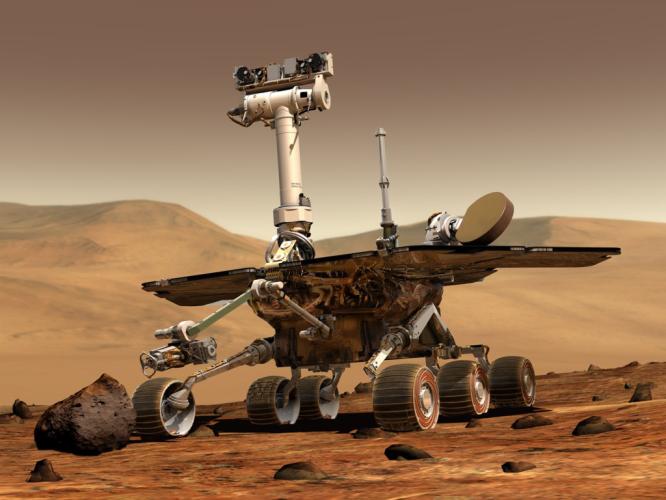
Farewell, Opportunity. This six-wheeled solar-powered rover approximately the size of a golf cart has been immobile and unable to respond to radio signals since it entered a power-saving contingency mode during a sun-blocking dust storm on Mars during the summer of 2018. After more than a half year of effort to re-establish communications with Opportunity, NASA declared on Wednesday that Opportunity’s mission has come to an official end. Opportunity began exploring the flat plains of Meridiani Planum after its landing on Jan. 25, 2004, and defied all odds by surviving more than 55 times longer than originally anticipated. You read that correctly; fifty-five times longer. She was only supposed to survive for 90 days.
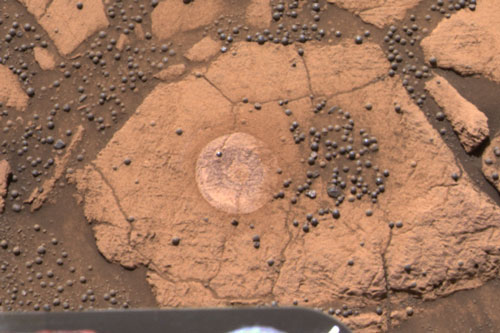
Opportunity was the second of the two twin Mars Exploration Rovers to successfully land on the surface, preceded three weeks earlier by Mars Exploration Rover-A (“Spirit”). Unlike Spirit, whose primary mission successes came later in its mission, Opportunity was a complete success from the moment she landed. Opportunity landed at the bottom of a small impact crater, exposing sedimentary layers just a few meters from the rover itself. The composition of these sedimentary rocks also indicated that liquid water must have been present for extended periods of time in order to match the chemistry and mineralogy of these sedimentary units. Within just a few days of landing, Opportunity had already successfully identified geologic units that were once saturated with liquid water, and the mystery of whether liquid water had played a major role at or near the martian surface was officially solved.
Opportunity continued to uncover interesting geologic information about Meridiani Planum and, more generally, Mars as a planet, over the remainder of her 45-kilometer traverse across the martian landscape. Opportunity studied the first cross-bedded sandstones ever observed on another planet. She also determined that the water that has since altered these sandstones must have been highly acidic to reproduce the elemental and mineralogical composition of this unit. The majority of Opportunity’s discoveries have come in the form of (no pun intended) opportunistic observations or measurements resulting from the rover’s longevity and overall health. For these reasons, the scientists and engineers who designed, built, tested, calibrated and commanded this rover and her scientific payload are the true discoverers of these data.
Though a sad day in the martian science community, nobody could have ever initially imagined that Opportunity would survive for 15 years on the martian surface, and for that we can only be thankful. There is little doubt that the reputation and scientific legacy of Opportunity will live on forever. Until we explore Meridiani Planum once again with either robotic or human explorers, we wish Opportunity good night, and thanks for all of your hard work and perseverance in helping us to learn more about the martian surface than we could have ever hoped.
Mark Salvatore is an assistant professor in the Department of Physics & Astronomy. He studies the formation and evolution of planetary surfaces, including significant time spent studying the cold desert environments on Earth, which are similar in nature to these surfaces. He just returned from a weekslong research mission to Antarctica. Salvatore also is part of the Mars Curiosity rover lab at NAU.
Source: Rest in Peace, Mars Exploration Rover-B, AKA Opportunity: Jan. 25, 2004-Feb. 13, 2019