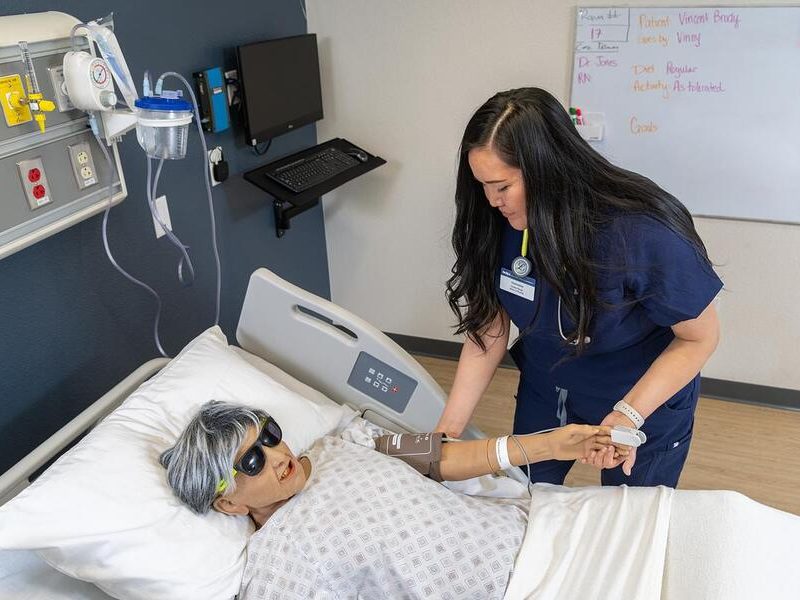
Answering the Call: Carletta Ami’s Path Through the American Indian Nursing Program
Carletta Ami has always been told that she was meant to be a nurse. Friends, mentors, and colleagues consistently recognized her compassion, empathy, and dedication to helping others, long before she considered the profession herself.
“I had so many people tell me that because of my caring way and willingness to help, I should go into nursing,” Ami recalls. “I laughed at them.”
Their encouragement proved true, guiding her toward a successful career as a nurse.
Her path to nursing, however, was far from linear. Originally pursuing a career as a dietitian, Ami found herself repeatedly encouraged by family and colleagues to consider nursing. At the time, this only made her more adamant about becoming a dietitian. But after working as a nursing assistant at St. Joseph’s Hospital in Phoenix, she realized that nursing could be in her future. Ami began taking prerequisites and exploring nursing more seriously, but life had other plans.
When Ami’s family started a small electronics business, she decided to put her studies on hold to return home to Polacca, a community on the Hopi Reservation, to help with the family business. Eventually, she joined the Indian Health Service (IHS), where she worked first as an optometry technician, then later as secretary to the Director of Nursing, and eventually secretary to the Director of Quality Management. It was during this time that her boss recognized her potential, encouraging her to pursue her nursing degree: “Carletta, you’re the best secretary I’ve ever had, but… You need to go back to school and get your degree. You need to be a nurse.”
Even with encouragement from her mentor, Ami had a lot on her plate. She was working full-time and raising her young son. Then a former classmate from NAU’s Ganado satellite program stepped in with a clear goal: help Ami take the one course she needed to enter the NAU American Indian Nursing Program (AIP). Her classmate arranged funding, helped Ami secure textbooks, and told her, “The one class that you need starts Friday. All you have to do is show up.” With that push and support from colleagues at IHS, Ami attended class that Friday and took a step toward the nursing career she had been encouraged to pursue for years.
The AIP is designed to prepare Native students for careers as registered nurses, providing hands-on clinical experience, mentorship from faculty, and a supportive peer community. The program equips students to meet the unique healthcare needs of tribal and rural communities while helping address the critical shortage of Native nurses.
Ami’s journey through the AIP was a pivotal point in her career. During her time in the program, she gained hands-on clinical experience through rotations in Ganado, Chinle, Gallup, and other communities. Reflecting on the support once in the program, “We got really close. We were like family,” recalling how students would study together, share accommodations, and support one another throughout the program. She continues, “I really feel like the nursing program did a lot for me … The professors really put a lot of faith in me and that had a lot to do with my confidence.” The program not only prepared her for nursing but also fostered friendships that have lasted decades. “We [all] developed a really good relationship that I know will be a lifetime relationship,” she says.
Ami is passionate about encouraging Native students to pursue nursing. “This program is a unique opportunity,” she says. “If anyone is able to take advantage of it and they really want to be a nurse, this is the way to go.” She emphasizes the importance of Native nurses, noting that, “the nurses that we’re able to retain (at IHS) are our native population because this is home to them…they understand what the population needs.”
When asked what advice she would give to aspiring nurses, Ami is clear: determination is key.
“If you’re committed, you’re going to succeed,” she says. She encourages students to take full advantage of the resources available through programs like the AIP, where faculty and mentors provide guidance when students need it most, whether that’s support with coursework, help navigating clinical rotations, or encouragement to keep going when challenges arise.
“You’ll always have a career in nursing, no matter where you go,” Ami adds. “It’s an essential, rewarding profession where the work you do truly makes a difference in people’s lives.”
Contributed by Business Administration, Marketing undergraduate student, Katie Fahy