CONTACT
TVR PATH
Tribal Vocational Rehabilitation
Personalized Approach to Traditional Holistics
Overview of TVR PATH Accordion Closed
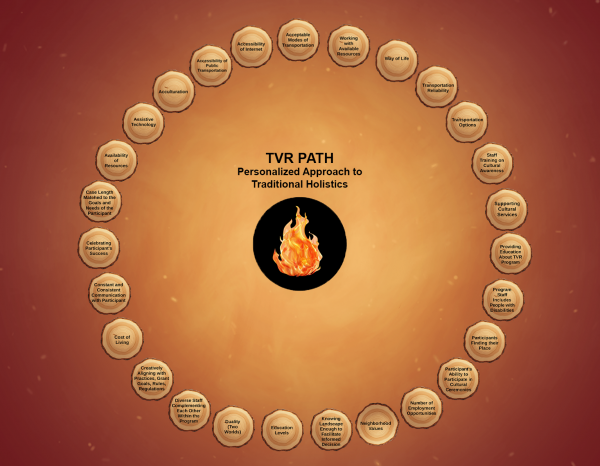
Tribal Vocational Rehabilitation Personalized Approach to Traditional Holistics (TVR PATH) is a tool designed to support the provision of Cultural Services within Tribal Vocational Rehabilitation (TVR) programs. At its core, TVR PATH features a diagram describing key elements that directly and indirectly help program participants receive Cultural Services. These include any services provided to a participant that reflect their cultural background and are necessary for their successful employment.
The name of this tool emphasizes the personalized nature of supporting TVR program participants and the holistic approach to working with them. Program participants aren’t simply placed in a job; they are served and supported as whole people and members of their communities, with all the complexities of their intertwined strengths, resources, priorities, concerns, abilities, capabilities, interests, and choices. Recognizing these interconnections, TVR PATH promotes a holistic approach to service delivery.
TVR PATH was developed through an inclusive, community-driven process that involved interviews, focus groups, and feedback from TVR directors, counselors, and other Tribal partners. Each element of the diagram reflects a shared understanding of the conditions that support meaningful employment outcomes for Tribal members with disabilities.
This resource is intended for both new and seasoned TVR directors, counselors, and program teams. It serves as a guide for those who want to improve planning, training, and services in ways that respect Tribal culture. TVR program directors have suggested using it to support new staff training, strategic planning, and community engagement.
Importantly, TVR PATH is not a rule book or list of regulations. It does not replace important resources such as AIVRTTAC’s TVR Journey Guide or decision-making tools based on the Code of Federal Regulations (CFR). Rather, it adds to these resources by offering a wider, big-picture view shaped by Tribal community knowledge and experience.
Because each TVR program is unique, TVR PATH is meant to be a starting point. While it could be used “as is”, programs are encouraged to personalize it by changing the wording, layout, or images to reflect their culture and community. This website includes background information on how TVR PATH was created, an explanation of how the tool works, and two guides for personalizing it: one focused on visual design and another for adjusting the content so the final version fits your specific TVR program.
Overview of CARE Accordion Closed
The Culturally Appropriate Research in American Indian Employment (CARE) project was led by the Institute for Human Development and funded by the National Institute on Disability, Independent Living, and Rehabilitation Research (NIDILRR). It was carried out between September 1, 2020, and August 31, 2025, and focused on TVR programs, which help Tribal members with disabilities prepare for, get, and keep jobs. Unlike state Vocational Rehabilitation (VR) programs, TVR programs focus on the Tribal cultures of the people they serve. This includes offering Cultural Services to each participant that may help them reach their employment goal. Because there is little research on how TVR programs work, CARE used a community-based participatory research approach, which involves community members in planning and conducting the research. A council of advisors from American Indian/Alaska Native TVR programs helped shape the project’s goals and research design. Later, TVR staff helped improve the design, create a visual diagram, and analyze data. The project’s goal was to identify the practices and policies that support people with disabilities in achieving their employment goals through TVR, particularly those that focus on being responsive to and respectful of Tribal cultures.
Brief History of the Development of TVR PATH Accordion Closed
Development Process
Community input guided the creation of the TVR PATH tool, reflecting the experiences and knowledge of people working in TVR programs. With guidance from a council of TVR directors, it began as a research project that gathered feedback from TVR directors, counselors, and program participants through interviews and focus groups.
From those conversations, it became clear that a visual diagram of the system was needed. The diagram was created step by step. First, a small group of TVR experts shared basic information about what works well in the TVR system and what challenges participants often face. Later, members of the Consortia of Administrators in Native American Rehabilitation (CANAR) were invited to participate. Altogether, more than 180 individual comments were gathered on physical and virtual sticky notes at CANAR conferences in June and December 2024. Themes from the focus groups and interviews supported the information in these notes.
A group of five TVR directors then took part in workshops where they used their expertise to combine all 180 comments into the 27 elements shown in the diagram. They also discussed how the elements relate to each other. A draft diagram was then shared in a webinar with 60 TVR professionals, who gave feedback that helped shape the final version. This feedback informed the final product. By inviting a large number of people who are directly connected to TVR to participate in the project, each with their own different experiences, the resulting visual reflects the diversity of the TVR community.
Diversity Shaped TVR PATH
The five TVR directors who took part in the workshops came from TVR programs across the country. They brought a wide range of personal, professional, and cultural experiences. Each director offered a unique perspective shaped by their career, personal challenges, cultural background, and the communities they serve. Their viewpoints were also shaped by their positionality, meaning their life experiences and identities influence how they see the world and present themselves to others. This diversity helped shape TVR PATH.
Professional Diversity: The TVR directors who took part in the workshops brought a wide range of professional experiences. Some had over 20 years in TVR, while others were newly appointed and learning to navigate their first grant cycles. Several came to the field due to personal experiences with TVR, including former program participants or people inspired by mentors or community needs. Their roles included program management, counseling, education, youth advocacy, and Tribal governance, with many taking on multiple responsibilities in their communities.
Cultural and Community Backgrounds: The TVR directors in the workshops came from many different Tribal nations and regions, from remote communities to large reservations, showing the wide reach of TVR services. They brought strong cultural roots, including fluent language use, Traditional ceremonies, and teachings passed down through generations. Some grew up outside Native communities and faced unfair treatment, while others returned to their home communities from elsewhere to seek healing and reconnect with their culture.
Life Experiences and Challenges: The TVR directors in the workshop shared stories showing great strength and determination. Several had experienced or witnessed addiction, homelessness, social or organizational barriers, or personal loss, and they used these experiences to guide their leadership. Their real-life experiences helped shape how they work and understand the clients they serve, many of whom have faced similar challenges.
Shared Values and Leadership Qualities: Despite their different backgrounds, the TVR directors shared common values: community service, humility, honesty, humor, faith, and keeping their culture alive. They felt a strong responsibility to “give back” to their communities, often taking on leadership roles because their community needed them or encouraged them to. They highlighted the importance of working together, staying spiritually grounded, and treating everyone with respect and dignity, no matter their position.
Honoring What We Know and What We’re Still Learning: The group recognized that, while their shared knowledge was valuable, it was not complete. The TVR directors in the workshop openly admitted the limits of their viewpoints, especially when it came to representing all TVR program sizes, urban versus rural settings, and the many different Tribal cultures across the country. Others reflected on generational differences and how cultural understandings and professional practices have changed over time, and noted that younger staff may hold different roles or viewpoints than their elders.
TVR PATH Accordion Closed
TVR PATH is a flexible tool, offered in three formats to match different needs and preferences.
 Interactive diagram with animations: This version lets users zoom in to read labels more clearly. After exploring an element, users return to the main overview before looking at a new one, providing a structured, circular way to understand TVR PATH.
Interactive diagram without animations: This version does not use animated transitions. Users can click on any element and follow their own “train of thought” without returning to the main overview between exploring different elements. However, this flexibility can lead users to focus on just one part and lose sight of the full 27-element diagram.
Static PDF version: This printable version encourages a step-by-step approach to understanding TVR PATH, offering a simpler alternative to the circular exploration of interactive diagrams.
TVR PATH is shown as a fire surrounded by logs, serving as a visual representation of the tool. One way to understand it is to see each log as representing an element that fuels the fire, showing that every part of the system is important for providing meaningful services based in Tribal culture. These logs can also represent seats around the fire, symbolizing the people and relationships that give the fire its purpose. If these ideas don’t fit your local community, the toolkit includes tips for changing the image to better match your culture.
Each log represents one element of the TVR system that is connected, directly or indirectly, to Cultural Services provision. All elements are essential, so there is no ranking of importance. They are shown in alphabetical order, starting at the top of the circle and moving counterclockwise. If this order does not fit your community’s perspective, you can rearrange the elements in another way that makes sense for your culture. These elements are all connected, and to understand TVR PATH it is necessary to see these relationships. Clicking on an element in the interactive diagram opens a sub-diagram (a detailed view showing all its connected elements). There is a sub-diagram for each of the 27 elements.
The labels on each element (such as “Availability of Resources” and “Celebrate Participant’s Success”) are short and show the main idea of the element. However, the labels alone are not enough to fully understand each element, especially when looking at how they connect to others. Each element has a more detailed definition, which can be found in Elements in TVR PATH and Their Definitions and is also shown in each element’s sub-diagram.
Elements in TVR PATH and Their Definitions
Acceptable Modes of Transportation
This refers to having reliable vehicles for getting around, both for program participants to reach their employment goals and for TVR program staff to do their work. It also includes the program’s ability (or inability) to provide suitable vehicles when they are needed as part of the participant’s individualized plan for employment (IPE).
Accessibility of Internet
This includes several aspects of internet access and use, including quality, reliability, and speed. It also considers whether a person has a dedicated connection that is always available (like at home or work) or if they rely on community hotspots, which may only be available at certain times or have limited bandwidth. Home hotspots may be affected by cellular signal strength. Another factor is whether the person has a device that can connect to the internet.
Accessibility of Public Transportation
This refers to how easy it is to use public transit, including schedules, routes, and stop locations. It also includes whether the transit system can accommodate people with disabilities, such as those using powered wheelchairs.
Acculturation
This is the ongoing process of adapting to non-Native systems (such as education, work, or government) while staying connected to Indigenous identity and values. It means navigating cultural differences while striving to stay strong, balanced, and rooted in cultural identity.
Assistive Technology
This includes tools, devices, and strategies that help people participate in work and related activities, such as managing tasks, communicating with coworkers and accessing training centers or workplaces. These reduce barriers related to disability, communication, mobility, or organization.
Availability of Resources
This refers to having essential supports that are accessible, such as family, schools, service providers, medical care, and affordable housing. It also includes culturally important natural resources that follow seasonal cycles, such as plants, roots, berries, and animals used in traditional ceremonies and practices.
Case Length Matched to the Goals and Needs of the Participant
This means TVR services and timelines are flexible, allowing support to be tailored to each person’s unique circumstances, strengths, challenges, and personal or work goals, instead of following a set schedule.
Celebrating Participant’s Success
This means intentionally giving encouragement, celebrating small achievements, and honoring major personal, educational, or work accomplishments in meaningful ways.
Constant and Consistent Communication with Participant
This refers to ongoing, reliable contact between staff and participants. It helps identify new needs, shows care and presence, and supports the participant’s growth by being a steady, trustworthy figure in their life.
Cost of Living
This refers to the total expenses needed to maintain a basic standard of living in a particular area, including housing, food, transportation, utilities, and healthcare. Costs can vary greatly in Tribal communities due to remoteness, limited services, and changing in access to affordable goods.
Creatively Aligning with Practices, Grant Goals, Rules, and Regulations
This means designing and conducting program activities in ways that meet community needs while still following federal rules and funding requirements, often working closely with finance offices and grant administrators.
Diverse Staff Working Together Within the Program
This is about recognizing and using the different strengths of team members, such as education, life experience, work background, social connections, and personality, in order to create a stronger, more supportive, and well-rounded service team.
Duality (Two Worlds)
This refers to living confidently in both Indigenous and Western worlds. It means keeping cultural identity and traditions while succeeding in the larger community. Duality means combining both worlds, using the strengths of each to help yourself and uplift the community. One TVR director’s granddaughter described it as “a high heel on one foot and a moccasin on the other.”
Education Levels
This refers to the variety of learning backgrounds among staff and participants, including Indigenous ways of learning and Western-style education. It recognizes that many people may have limited formal schooling and highlights the value of community-based knowledge in supporting program success and participant growth.
Knowing the Landscape to Support Informed Decisions
This refers to a staff member’s ability to understand and share local, regional, and cultural opportunities, such as job options, educational paths, and traditional activities, so participants can make meaningful choices that match their values, strengths, and goals.
Neighborhood Values
This refers to the social and environmental aspects of a community that affect quality of life, including schools, local opportunities, way of life, whether it is a good place to raise children, and whether it is a low- or high-stress place to live.
Number of Employment Opportunities
This refers to the availability and variety of jobs in a region, shaped by factors such as location, seasonal industries, Tribal businesses, and access to transportation. These factors affect a participant’s ability to find and keep meaningful work.
Participant’s Ability to Take Part in Cultural Ceremonies
This refers to how easily a person can participate in traditional practices. It depends on factors such as access to ceremony locations, seasonal availability of important materials, and personal or social barriers that might make participation harder.
Participants Finding Their Place
This means helping TVR program participants recognize their strengths and challenges in a positive way, instead of focusing on their disability. It involves supporting them in seeing the value they bring to their family and community, creating a sense of purpose, belonging, and cultural connection.
Program Staff Includes People with Disabilities
This refers to including team members who have personal experience with disability. The entire staff learns from their insights, which helps everyone better understand and connect with participants, set realistic goals, identify challenges, and advocate for participants’ needs.
Providing Education about TVR Programs
This means clearly explaining what the TVR program is, what it does, and who it serves. This helps community members, other programs, and partners understand the program’s purpose and benefits, and makes it easier to refer the right people for support.
Supporting Cultural Services
This means helping participants take part in culturally rooted practices, such as ceremonies, gatherings, teachings, and seasonal activities, as part of their work journey. It involves creating access, respecting diverse Tribal traditions, and including cultural expression in service planning in respectful, community-guided ways.
Staff Training on Cultural Awareness
This means giving both Tribal and non-Tribal team members opportunities to learn about different Tribal cultures so they can understand, respect, and include cultural traditions, values, and practices in their work.
Transportation Options
This refers to the roads, travel options, and systems people use to get around. This includes road quality, the need for special travel methods (such as flying or using snowmobiles), and wear and tear on vehicles. These factors affect how easily people can get to work, services, and community events.
Transportation Reliability
This means how dependable transportation is, including the condition of vehicles or buses, the reliability of drivers or services, and the effects of weather. These factors determine whether people can consistently get to work, appointments, or community activities.
Way of Life
This refers to how people live and connect to their culture, shaped by family history, community, and personal identity. Everyone’s connection to their traditions is different and affects how they approach services, responsibilities, and goals.
Working with Available Resources
This means making the most of the tools, supports, and program staff or community partners available to accomplish tasks. It shows creativity, problem-solving skills, and a strong commitment to helping others, even when resources are limited.
Using TVR PATH in TVR Work Accordion Closed
Many people in TVR have said they want to use TVR PATH to support their work with TVR program participants, train new staff, and help with grant writing. The following examples show how TVR PATH can be used in these situations.
Working with TVR participants
The comprehensive assessment (called the Great 8) is an ongoing process, taking place during every interaction with a TVR program participant. It looks at the participant’s strengths, resources, priorities, concerns, abilities, capabilities, interests, and informed choice.
TVR PATH strengthens the Great 8 comprehensive assessment by showing areas to explore and giving a more holistic (complete, “big picture”) view. For example, during the comprehensive assessment, you may find that the local bus (a resource) is an acceptable mode of transportation because it serves the participant’s home and matches their work schedule. You may also learn that your participant wants to take part in Cultural ceremonies (an interest). Using TVR PATH, you are encouraged to think deeper: the sub-diagram for acceptable modes of transportation connects to 13 other elements, including the participant’s ability to take part in Cultural ceremonies. You might see that the local bus schedule does not allow attending a ceremony they care about, which prompts you to look for other transportation options or note it as a concern. TVR PATH helps you see these connections and think about them during the comprehensive assessment, giving you a more holistic understanding of the program participant’s strengths, resources, priorities, concerns, abilities, capabilities, interests, and informed choice. Looking at the whole system also helps identify potential barriers to employment, which is important when developing an individualized plan for employment (IPE).
For IPE planning, you might note that the bus can be used for most of the services and activities needed to achieve the employment goal. However, it does not support participation in a specific cultural ceremony included in the IPE. TVR PATH prompts you consider alternative supports (supporting Cultural Services). This may include working with resources available (such as borrowing a car from a friend or working with the community to adjust the ceremony location when possible) or providing another transportation option. This ensures the participant can fully take part in Cultural Services.
Staff Training
The TVR PATH diagram can be used to onboard (train) new staff. It helps them see a shared picture of how a TVR program works, which can speed up the onboarding process. Current staff members can review the TVR PATH tool with new employees, allowing the new staff member to listen, observe, and ask questions while learning about the TVR program.
Grant Writing
TVR PATH can be useful for two common types of grant proposals. The first is the AIVRS Grant Competition, sponsored by Rehabilitation Services Administration (RSA) in the U.S. Department of Education. Grants provided by RSA fund individual American Indian Vocational Rehabilitation Services (AIVRS) projects under the Workforce Innovation Opportunity Act of 2014. Unlike state VR programs, which do not compete for grants but instead receive a set amount of money from RSA, TVR programs must apply for competitive AIVRS grants. TVR programs also focus on respecting Tribal culture and making sure participants can take part in Cultural Services. Explaining how the program will ensure that participants’ Tribal cultures are taken into account in service delivery is an important component of AIVRS grant applications, and TVR PATH can support this section by showing how Cultural Services connect to other parts of the TVR system, including some that are not immediately obvious.
The second type of grant proposal is for supplemental or partnership grants, which support program growth or build partnerships that expand services. For these proposals, TVR PATH can be useful in two ways. First, it can help your team see where there are gaps in the services that affect participants, some of which may be outside the program’s direct control, requiring new partnerships or joint initiatives. This makes TVR PATH a helpful tool for strategic planning and deciding what kind of grants to pursue. Second, TVR PATH can act as a visual aid in the proposal itself. It helps communicate these gaps and needs to potential partners and funders, making it easier for them to understand the full picture of your program and why certain partnerships or supplemental funding are needed.
Personalizing TVR PATH Accordion Closed
You may want to personalize TVR PATH for your program by changing the visual appearance and/or the words used to describe the elements, their definitions, and their connections. If you want to change both, it may help to start with the elements and their connections, since that can affect how the visual is organized. Either way works. The most important part is to make TVR PATH your own, so it makes sense to your staff, participants, and partners.
Deciding on a Visual Approach
Start by checking if the elements, their connections, and the diagram image reflect your program. You can use a simple green (fits)/yellow (needs change)/red (does not fit) review with staff, Tribal Elders, participants, and partners to spot gaps or mismatches. If the fire image doesn’t fit, choose one that better reflects how your community thinks about time, movement, and gathering. This could include a medicine wheel (cycles and seasons), teepee poles (supports coming together), basket weave (working together and strength from crossing strands), canoe/journey (finding your path), spiral or river current (flow and change), or storm or wind (motion and forces). For your chosen image, decide what represents elements (like spokes, poles, strands, or channels). Make sure the image can show both stability and change before moving to sketching.
Map each element to a part of the image, then redraw the connections. Remember that changing a label or definition may also change how elements connect. Work together with staff, Tribal Elders, participants, and partners in short, repeated sessions. For the final version, choose colors, patterns, and design features that ensure the diagram is accessible to people with disabilities. The goal is to create a picture that is clearer, respectful, and meaningful to your community.
It is critical to use visuals that avoid cultural stereotypes. Choose images and symbols carefully and with permission, keeping in mind that some colors, songs, animals, plants, objects, and numbers are sacred or belong to certain families or societies. If your design has a set structure (such as four directions or seven poles), do not force your elements to fit that number. Either personalize the elements and their relationships or pick a different image that naturally fits them. Ask keepers of cultural knowledge and language which parts are appropriate for public use and which should stay private. If you are unsure, use simple shapes, land or water forms, or everyday tools. Always credit artists, note any limits on sharing the image, and keep sensitive details out of labels and notes. Avoid mixing symbols from different Tribes. Be sure to follow local practices and always get approval from cultural keepers for changes.
Personalizing the Elements and Their Relationships
As you explore the diagram, you may notice that some elements or their connections do not fully match your program, or that an important element is missing. For example:
- You might feel that housing, like transportation, plays a bigger role and should be listed separately instead of being grouped under availability of resources.
- The accessibility and quality of vocational rehabilitation services may not be fully captured under the availability of resources
- You may find that the term duality (two worlds) does not fit, since we all live in one world, even with different societies and tensions between them. It may make more sense to link it to Acculturation rather than treating it as a separate element.
Noticing things like this means the content and connections in TVR PATH may need to be personalized for your program.
Any changes to the elements (adding, removing, combining, or editing definitions) also affect the relationships between them. TVR PATH is strong because it was created by many people, so it is important to make changes as a group rather than alone.
This section gives a simple approach for modifying TVR PATH to better fit your program. Detailed suggested activities are in the tools and resources section to guide you through the process.
Who to include in the conversations: All TVR program staff should be part of conversations about revising TVR PATH. It may also be helpful to include others who have a close relationship with your program, such as service providers, program participants, Tribal Elders, and partnering programs. If you do not have a strong relationship with your partner programs yet, this is a good opportunity to introduce yourselves. One TVR director suggested making a short presentation about your program and inviting partners to do the same. This helps everyone understand the program and work together to support program participants. When revising TVR PATH’s content, learning about partner programs may reveal important points of view to include in your discussions.
Everyone should commit to active participation throughout the process, since occasional attendance makes discussions less helpful.
What to discuss: Start by making sure everyone understands the elements in the original version of TVR PATH. Next, talk about your program and how it connects to each element. From there, decide if any elements should be changed, added, or combined. This will result in a set of elements that fits your program.
After finalizing the elements, discuss the relationships between them. This is an ongoing process: as you talk about connections, you may notice that some definitions do not fit your program and need to be updated. If you change a definition, review all relationships again to see if they need to be updated as well.
When to have discussions: There is no single “best” time to hold these conversations. Most programs would start when they notice gaps in TVR PATH as they start using it. Some programs may choose to start personalizing it as soon as they learn about it.
Plan for each session to last a couple of hours and schedule several group meetings. Meetings should be held close enough together for participants to remember previous discussions, but spaced to allow time to reflect between sessions. Weekly meetings are recommended, though meeting more than twice a week is probably unrealistic. To fully cover all the elements and their relationships, expect about 8–12 meetings. This will allow everyone to share their stories, which are essential for understanding the system, while still making progress without rushing important discussions.
Where to have discussions: While TVR PATH was originally developed through virtual meetings because workshop participants were spread across the country, another option could have been a multi-day in-person retreat. While this would have removed some scheduling and technology barriers, it would have left less time for reflection during the development process.
For your group, it would be best to meet in person in a quiet, distraction-free place. Even for short sessions, pick a place with few interruptions, like outside the office, closing it so all staff can attend. The space should support honest conversation, with seating arranged so everyone can see and hear each other clearly. Make sure the space is comfortable so participants can focus on the discussion instead of their physical needs.
How to have discussions: The Tools and Resources section includes activities to guide your conversations. These activities help you review how TVR PATH relates to your program, develop your list of elements, and identify the connections between the elements. You can revisit these stages as needed during your meetings. It is best to complete the activities in order. Each activity can take a different amount of time and may require multiple sessions to finish.
Prezi Resources
The starter diagrams were made using Prezi. You can start from scratch to create your own diagram, or you can save and modify the version we developed. To get a copy of the Prezi files, please complete the request form. Files are usually sent within five business days, though often faster. If you have problems with the form, please contact meghan.donahue@nau.edu. Please note that there are two tools within Prezi. Prezi Present is the tool used for the interactive diagram with animations and Prezi Design is the tool for the interactive diagram without animations. There resources below for each of those tools.
Helpful resources for working with the files :
- Designing more accessible Prezi Presentations
- Logging in to your Prezi account
- How to create a Prezi account and import the diagram emailed to you (coming soon)
When You’ve Finished Personalizing TVR PATH
As you finish up your personalized TVR PATH, make sure to protect Cultural knowledge. Check with your Tribal Elders to decide what can be shared publicly and what should stay within the Tribe(s).
You are invited to share details about your personalized version through this portal. You decide how much to share. You may simply indicate that you personalized TVR PATH and note whether you changed the visuals, elements and their relationships, or both. Alternatively, you may share your completed TVR PATH along with a short story explaining your version and why it works for your program. Some may choose something in between these options.
You can also control who can see your shared version. This might include the CARE team, AIVRTTAC, specific members of the TVR community as each request is received, or the entire TVR community.
Acknowledgements Accordion Closed
We’d like to thank the many people and groups who helped make TVR PATH possible.
First, we are grateful to the 18 TVR directors, counselors, staff members, and program participants who took part in interviews and focus groups early in the project. Their input helped identify the need for TVR PATH and contributed to many of the elements included in the tool.
We also thank the TVR directors, counselors, staff members, and partners who took part in workshops during CANAR conferences and AIVRTTAC webinars. Their input highlighted key parts of the TVR system that support program participants in reaching their IPE goals and accessing Cultural Services, helping create a full picture of TVR as a system.
Special thanks to TVR directors Lyle Cook, Feather Holt, Celeste Hunt, Christina Martinez, and Adrian Smith, who combined the data from the workshops and webinars to identify the 27 elements of TVR PATH, and shaped its final structure.
We also thank the CARE Advisory Council, including current members Lanor Curole, Jana Finkbonner, Paula Seanez, and Timothy Yeahquo, as well as Celeste Hunt and Marshal Longie, who were involved in earlier stages. They helped design the research project, found and invited participants, advised on the direction of the project, and provided guidance on developing and sharing TVR PATH.
Finally, we appreciate the staff of the American Indian Vocational Rehabilitation Training and Technical Assistance Center (AIVRTTAC) for supporting the CARE project, holding webinars to involve the TVR community, and giving feedback on the TVR PATH guide.
This work was supported by National Institute on Disability, Independent Living, and Rehabilitation Research (NIDILRR) under grant award 90IFRE0041. The findings from this project do not necessarily reflect the views of NIDILRR.
Useful Definitions: Key Words and Meanings Accordion Closed
AIVRS – American Indian Vocational Rehabilitation Services; a competitive federal grant program run by the U.S. Department of Education that funds TVR programs.
AIVRS Program – A federal program, carried out by the Rehabilitation Services Administration under the U.S. Department of Education, that gives grants to TVR programs. These grants fund vocational rehabilitation services to American Indians and Alaska Natives with disabilities who live on or near federal or state reservations. The services must follow the Rehabilitation Act of 1973 (amended by Title IV of the Workforce Innovation and Opportunity Act) and be culturally relevant, respecting each Tribe’s traditions, values, languages, and community setting.
AIVRS Project – A Tribal Vocational Rehabilitation (TVR) program funded by the federal AIVRS Program; synonymous with “TVR program.”
CANAR – Consortia of Administrators in Native American Rehabilitation.
CARE – Culturally Appropriate Research in American Indian Employment, the project funded by NIDILRR that led to TVR PATH.
Element – One part of the TVR system, shown as a “log” in TVR PATH. Each element connects to others in a sub-diagram.
IPE – Individualized Plan for Employment, a plan created with someone eligible for TVR or state VR services. It describes their job goal and the services needed to achieve it, agreed on by the counselor and program participant.
NIDILRR – National Institute for Disability, Independent Living, and Rehabilitation Research.
Prezi – The program used to make the interactive versions of TVR PATH.
Sub-Diagram – In TVR PATH, the main diagram shows all the elements of the system. Each individual element has a smaller sub-diagram that shows only the other elements connected to it.
TVR PATH – Tribal Vocational Rehabilitation Personalized Approach to Traditional Holistics. A visual tool that shows all the elements of TVR and how they connect.
TVR Program – A Tribal Vocational Rehabilitation program, which provides vocational rehabilitation services to American Indians and Alaska Natives with disabilities who live on or near federal or state reservations, usually funded through the AIVRS Program. This is the same as an AIVRS project and the services provided must be culturally relevant, respecting each Tribe’s traditions, values, languages, and community setting.
VR – Vocational Rehabilitation.
Disclosure on the Use of Generative Artificial Intelligence (AI) Accordion Closed
Website and TVR PATH Content
This content was developed with help from generative AI (OpenAI’s ChatGPT, 2025). A human guide directed every stage by deciding the purpose, selecting content, and shaping the overall framework. AI was used to organize, reword, and combine ideas to make them clearer.
AI contributed to early drafts of element definitions and summaries of diversity exercises. It helped clarify complex ideas and reduce repetitive work. In this way, AI was a helpful tool that made it easier to turn shared ideas into clear, usable materials while humans stayed in full control.
Using AI to Plan a TVR Director Workshop
Generative AI helped plan a guided discussion during the first workshop with five TVR directors. The goal was to explore the group’s diversity and understand the limits of their combined knowledge. This planning took place on April 29, 2025, using the Google Gemini Large Language Model (LLM). The LLM subscription included data protections, and the chat was not used to improve the model. While the exact version was not recorded, it was likely Flash 2.0 based on the subscription type and date.
To create the discussion framework, the human asked Gemini the following question: “I’m conducting a workshop with five Tribal Vocational Rehabilitation Program directors from across the country. I want to do some sort of exercise in about 15-20 minutes that helps them identify all the different kinds of diversity in the group. Can you please help me propose an exercise and provide sources for why this is a good approach? I’d like to keep it culturally sensitive.” Gemini suggested an exercise, which was revised over six follow-up prompts. After seven versions, the human user finalized the discussion questions. The exercise included key points for the facilitator and prompts for participants. It was delivered using slides and a facilitator script developed by the human user based on Gemini’s suggestions. The full set of prompts and the final exercise are saved and can be shared on request.
This exercise was later adapted to create “Element Personalization Activity 1c: Recognizing Your Collective Strengths”. These further adaptations were created without assistance from AI.
Tools and Resources Accordion Closed
Element Personalization Activity 1: Setting the Table
Element Personalization Activity 1 Setting the Table
Element Personalization Activity 2: Evaluating TVR PATH in Your TVR Program
Element Personalization Activity 2 Evaluating TVR PATH in Your TVR Program
Element Personalization Activity 3: Changing and Identifying Elements
Element Personalization Activity 3 Changing and Identifying Elements
Element Personalization Activity 4: Relationships Between Elements
Element Personalization Activity 4 Relationships Between Elements
Flashcards
Print double sided, flip on long edge, to ensure that the text on the cards lines up properly.
Sharing Portal Accordion Closed
This list shows the information that will be collected in the portal when you share your personalized version of TVR PATH.
- Name
- Contact information
- How did you adapt TVR PATH?
- Visual changes
- Content changes (elements, definitions, and/or relationships)
- Did you check with your knowledge keepers on what can be shared and with whom? (yes/no)
- What can you share about your adapted version?
- Brief description (short answer)
- Besides the CARE team, can we share this with:
- AIVRTTAC (yes/no)
- The AIVRS community on the CARE website (yes/no)
- The AIVRS community through individual requests (yes/no)
- If yes, who should these requests go to? (name/email/phone)
- Finished adapted version (upload option)
- Besides the CARE team, can we share this with:
- AIVRTTAC (yes/no)
- The AIVRS community on the CARE website (yes/no)
- The AIVRS community through individual requests (yes/no)
- If yes, who should the requests go to? (name/email/phone)
- Other materials or information: (please describe) (short answer)
- Besides the CARE team, can we share this with:
- AIVRTTAC (yes/no)
- The AIVRS community on the CARE website (yes/no)
- The AIVRS community through individual requests (yes/no)
- If yes, who should the requests go to? (name/email/phone)